


Summary
- 1) Key Takeaways
- 2) Introdution
- 3) Understanding T-Mobile International Roaming
- 4) How eSIM Technology Changes International Connectivity
- 5) Cost Comparison: T-Mobile Roaming vs eSIM Providers
- 6) Performance and Coverage Differences
- 7) Setting Up and Using Ubigi eSIM While Traveling
- 8) T-Mobile’s International Features Worth Keeping
- 9) Making the Right Choice for Your Travel Needs
- 10) Conclusion
- 11) Frequently Asked Questions
Key Takeaways
- If you don’t know how to decide between “T-Mobile International Roaming vs eSIM“, this article is for you!
- T-Mobile’s current premium plans include a limited bucket of high-speed data and permanently throttle you to slow 256 kbps speeds for the rest of your billing cycle once you hit that cap.
- Ubigi eSIM offers full-speed 4G/5G data plans with instant activation and no physical card swaps.
- T-Mobile charges $5/day for High-Speed International Data passes (512 MB at full speed), which adds up quickly on longer trips.
- Your Ubigi eSIM lets you keep your T-Mobile number active while using local data networks at native speeds.
- For business travelers or streaming needs, eSIM solutions like Ubigi deliver 50-100x faster speeds compared to T-Mobile’s throttled roaming.

Introdution
When traveling internationally with T-Mobile, you face a choice: stick with international roaming or switch to an eSIM provider. T-Mobile offers unlimited data through its Magenta and Go5G plans, but speeds are throttled to 2G (128 kbps).
eSIM providers like Ubigi deliver full-speed LTE/5G data with flexible prepaid options, often at lower costs for data-heavy users. This guide breaks down pricing taken on April 2026, performance, and practical differences to help you choose the right solution for your trip.
Understanding T-Mobile International Roaming
T-Mobile revolutionized international travel with free unlimited data roaming, but the reality requires closer examination. The carrier’s Magenta, Magenta MAX, Go5G, and Go5G Plus plans automatically work without activation.
What You Actually Get (on April 2026):
- A strict high-speed data cap (5GB on Experience More, or 15GB on Experience Beyond)
- Throttled data at 256 kbps once your high-speed cap is reached
- Voice calls at $0.25/minute
The 256 kbps throttled speed limitation means basic messaging apps work, but map navigation buffers constantly, and video streaming remains impossible. Web browsing feels like internet access from 2005.
T-Mobile offers High-Speed International Data passes for $5 per day, providing 512 MB at 4G LTE speeds. After burning through that half-gigabyte, you revert to 2G. For a two-week trip, you’d spend $70 for roughly 7 GB total, with no guarantee you won’t exceed daily limits.
How eSIM Technology Changes International Connectivity
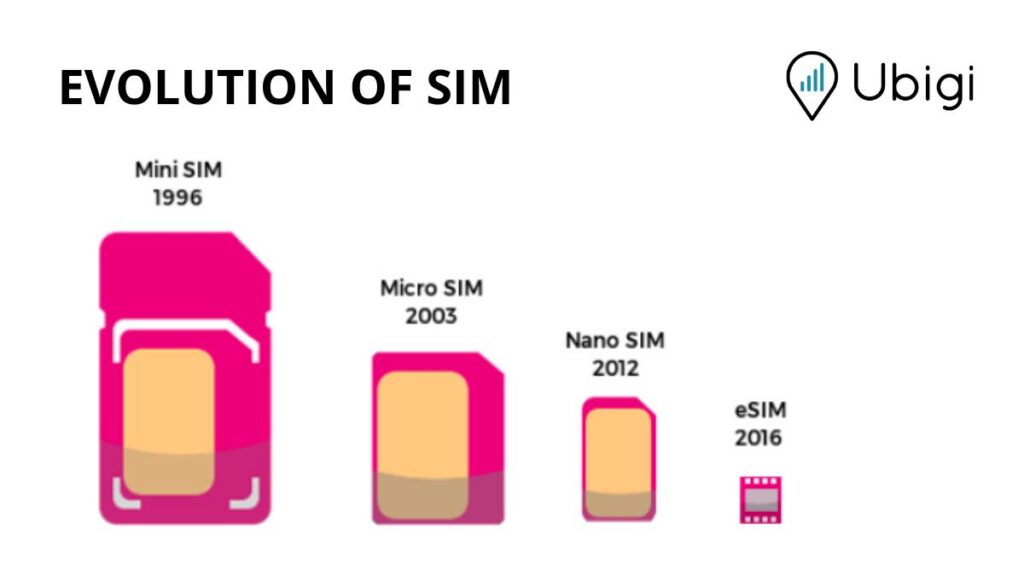
An eSIM (embedded SIM) is a digital SIM card built directly into your phone’s hardware. Instead of inserting a physical chip, you download a carrier profile through a QR code or app.
Technical Advantages:
- Instant activation within minutes
- Hotspot sharing
- No physical card damage or loss risk
- Remote provisioning from anywhere
With eSIM, you maintain your primary T-Mobile number for calls and texts while routing data through a local carrier network. Your iPhone or Android device switches between profiles automatically or manually based on your preferences.
Compatible devices include iPhone XS and newer, Samsung Galaxy S20+, Google Pixel 4+, and most flagship phones released after 2019. Dial the free shortcut *#06# : if you see an EID number, it’s yes!
Cost Comparison: T-Mobile Roaming vs eSIM Providers

Let’s analyze real-world costs for a typical 10-day European trip requiring 10 GB of data (prices taken on April 2026).
T-Mobile International Roaming:
- Included high-speed data: 5 GB
- Need 5 GB more? One 5GB Data Pass (10 days): $35
- Voice calls: $0.25/min (10 minutes = $2.50)
- Total extra cost: $37.50 to get a total of 10 GB of high-speed data
eSIM Solution (Ubigi example):
- 10 GB Europe plan: $15
- Full LTE/5G speeds throughout
- Installation time: 2 minutes
- Keep T-Mobile number active for calls/texts via Wi-Fi
- Total cost: $15 for complete high-speed coverage
The cost differential widens dramatically for business travelers or longer trips. A 30-day journey needing 40 GB would cost $150+ with T-Mobile passes versus $50-60 with a Ubigi eSIM (prices taken on April 2026).
Performance and Coverage Differences
| Feature | T-Mobile Roaming (Unthrottled High-Speed) | Our Ubigi eSIM |
| High-Speed Allowance | Strict cap (5GB or 15GB depending on plan). | Flexible (10GB, 50GB, or Unlimited data). |
| Download Speed | 20-100 Mbps (4G/5G) | 20-150+ Mbps (4G/5G) |
| Latency (Ping) | 250-500 ms (Traffic is routed back to the US) | 20-50 ms (Optimized regional routing) |
| Real-world Impact | Good speeds, but video calls may lag or echo due to high latency. Runs out very quickly. | Instant page loads, crisp and lag-free video calls, sustained performance. |
Coverage also differs significantly. T-Mobile’s roaming relies on partner agreements with varying quality levels. Some countries have excellent partnerships; others provide spotty service in rural areas.
Ubigi eSIM connects you directly to top local carriers. We partner with tier-one operators globally, ensuring premium network access. You get the same coverage quality as local residents, bypassing the deprioritization issues sometimes experienced with standard domestic carrier roaming.
Setting Up and Using Ubigi eSIM While Traveling
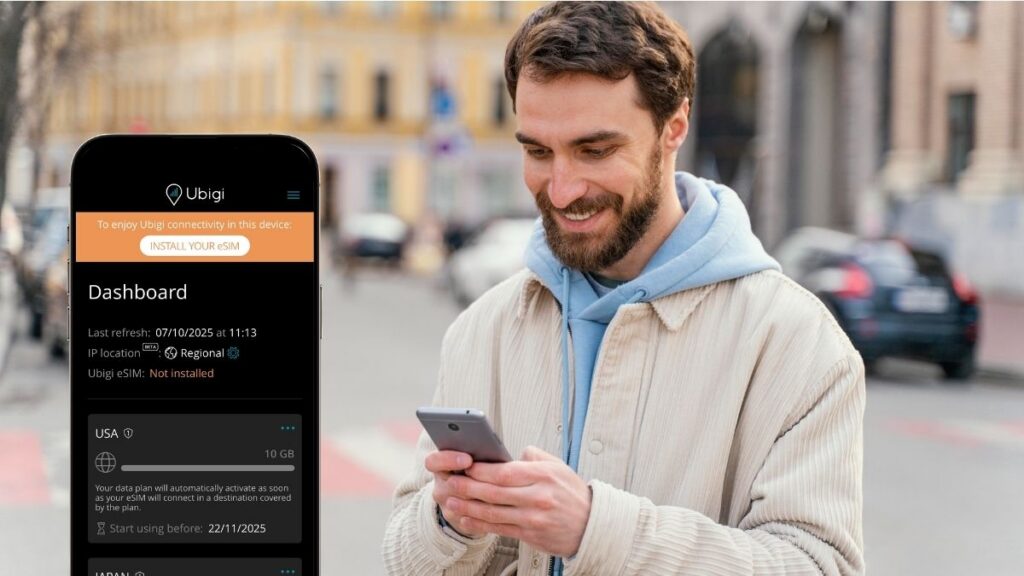
Activating a Ubigi eSIM takes under five minutes with proper preparation.
Pre-Departure Setup:
- Verify your device supports eSIM functionality
- Purchase eSIM data plan for your destination
- Download Ubigi app
- Install eSIM profile via QR code or app integration
Upon Arrival:
- Enable the eSIM data line in settings
- Set eSIM as “Primary” for cellular data
- Keep T-Mobile line as “Secondary” for calls/SMS
- Disable “Allow Cellular Data Switching” to ensure your phone doesn’t accidentally use your T-Mobile data bucket
- Connect and browse at premium local network speeds
Your phone manages both connections simultaneously. Incoming calls to your T-Mobile number still work (via roaming or Wi-Fi calling), while all data routes through the eSIM’s high-speed connection.
Ubigi app shows real-time data usage, plan expiration dates, and top-up options. You can purchase additional data packages mid-trip without visiting stores or dealing with language barriers.
T-Mobile’s International Features Worth Keeping
For travelers who primarily use messaging apps and occasional email checking, T-Mobile’s included 2G service suffices.
Valuable T-Mobile Features:
- Unlimited texting keeps your primary number accessible
- Wi-Fi calling works free when connected to wireless networks
- Simple Abroad feature provides clarity on costs
The sweet spot combines both solutions: T-Mobile for voice and SMS continuity and Ubigi eSIM for data-intensive tasks. This dual-SIM approach costs less than T-Mobile data passes while providing complete communication coverage.
Making the Right Choice for Your Travel Needs

Your ideal solution depends on specific usage patterns and trip characteristics.
Choose Ubigi eSIM Solutions If You:
- Need reliable high-speed data for work or navigation
- Travel frequently or for extended periods
- Stream content or join video conferences
- Want cost predictability and control
- Visit multiple countries in one trip
Business travelers consistently find eSIM options more cost-effective. A consultant visiting three countries over two weeks might spend $150+ on T-Mobile passes versus $50-60 for comprehensive eSIM coverage (prices taken on April 2026).
Digital nomads and long-term travelers benefit most from eSIM flexibility. Instead of paying monthly T-Mobile fees plus roaming costs, they use Ubigi eSIM as their primary connection and maintain T-Mobile on pause or use Google Voice alternatives.
Conclusion
Maximizing value requires strategic planning across both connectivity options. Optimize your connecitivity by downloading maps, entertainment, and work files before departure. You can also enable Wi-Fi calling on T-Mobile line to avoid per-minute charges.
Set your Ubigi eSIM as default data source to prevent accidental T-Mobile data usage and monitor your eSIM consumption through Ubigi’s app. Some travelers purchase smaller eSIM packages (3-5 GB) and rely on T-Mobile’s 2G for non-urgent background tasks.
This hybrid approach balances cost and convenience. We hope that this article on “T-Mobile International Roaming vs eSIM” helped you!

Frequently Asked Questions
Does T-Mobile charge extra for international roaming?
Premium T-Mobile plans (like Experience More and Experience Beyond) include a small bucket of 5GB to 15GB high-speed data in 215+ countries. Once you use that allowance, speeds drop dramatically to 256 kbps. Basic plans often throttle you to 256 kbps immediately. To get more high-speed data, T-Mobile sells International Data passes (e.g., $35 for 5GB over 10 days). Voice calls are always charged at $0.25 per minute.
Can I use eSIM and keep my T-Mobile number active?
Yes, modern smartphones support dual-SIM functionality, allowing you to use an eSIM for data while keeping your T-Mobile physical SIM active for calls and texts. Your T-Mobile number remains fully functional for incoming text messages (which are free to receive). However, keep in mind that answering a standard cellular phone call over T-Mobile’s network abroad will cost you $0.25 per minute. To avoid call charges, rely on VoIP apps like WhatsApp or FaceTime using our eSIM data.
How fast is T-Mobile’s international roaming compared to eSIM?
T-Mobile’s included international roaming provides 2G speeds at 128 kbps, which takes 30+ seconds to load basic webpages. eSIM connections to local carriers deliver full 4G/5G speeds of 20-150+ Mbps, roughly 200-1000 times faster. This difference makes streaming, video calls, and navigation practically impossible on T-Mobile’s standard roaming but seamless with eSIM.
How much data do I actually need when traveling internationally?
Average travelers use 3-5 GB per week for maps, messaging, social media, and occasional browsing. Heavy users streaming video or working remotely need 10-20 GB weekly. Consider your typical home usage and factor in additional navigation and travel research. Most eSIM providers offer flexible plans from 1 GB to unlimited options.
Is eSIM technology safe and secure for international travel?
eSIM technology uses the same encryption and security protocols as physical SIM cards. The digital profile is cryptographically secured and locked to your device. eSIMs actually provide better security since they cannot be physically removed if your phone is stolen, and you can deactivate them remotely through the provider’s app.
Can I switch back to my T-Mobile SIM after using eSIM abroad?
Your T-Mobile physical SIM remains in your device and stays active while using eSIM for data. You don’t need to remove anything. Simply change your cellular data settings to route traffic back through T-Mobile when you return home. The eSIM profile remains installed for future trips or can be deleted if no longer needed.
What happens if I run out of eSIM data while traveling?
Most eSIM providers allow instant top-ups through their mobile apps using credit cards or digital payment methods. You can purchase additional data packages within minutes without visiting stores or swapping SIM cards. Ubigi offers various data bundles that activate immediately, ensuring continuous connectivity throughout your trip.
Are there any disadvantages to using eSIM instead of T-Mobile roaming?
eSIM requires compatible hardware (iPhone XS+ or equivalent Android) and some initial setup time. You need internet access to download the eSIM profile initially. For most users needing functional internet speeds, an eSIM provides significantly better performance and often lower costs.







 How to check eSIM compatibility
 How to check carrier unlocking